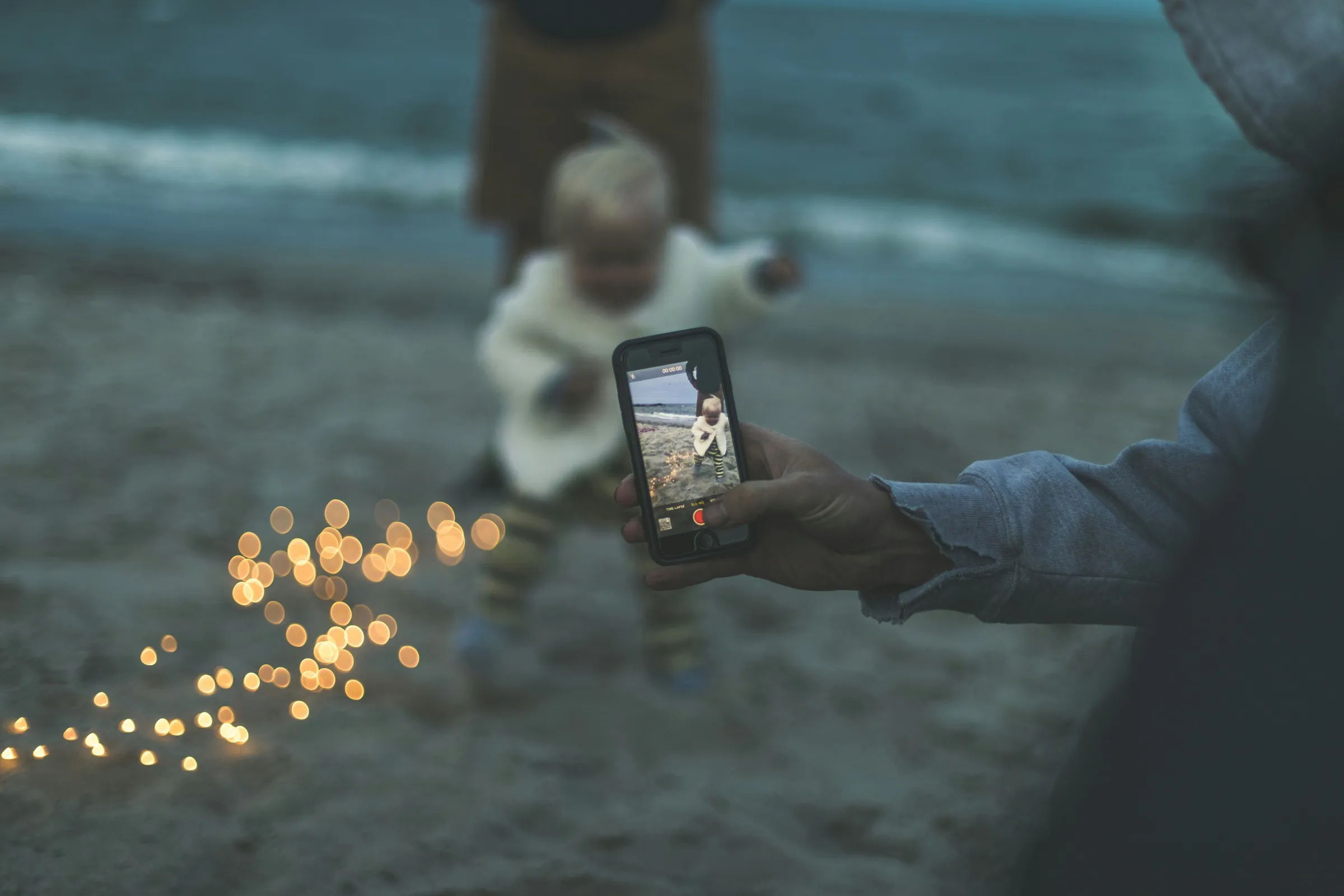
Before most children can walk, they already have a digital footprint: a trail of photos, names, dates, and locations scattered across apps and feeds. But a child’s digital footprint differs from your own in one crucial way: they didn’t create it. You did, and grandparents did, and the nursery did, all with love and none of it with the child’s say-so. This is a plain look at what that footprint really is, why permanence and consent matter more than the risk headlines, and a practical way to keep the trail small, without disappearing from your family’s life online.
What a child’s digital footprint really is
A digital footprint is the record of everything about a person that exists online. For an adult, it’s a mix of things they chose to post and things quietly collected about them. For a young child, it’s almost entirely the first kind, created by other people.
That footprint has two layers:
- The active layer: the photos, videos, captions, and updates adults deliberately post, the birthday album, the first-day-of-school snap, the funny quote in the family group.
- The passive layer: the data that rides along invisibly, location tags baked into photo files, timestamps, the metadata that says exactly where and when a picture was taken.
For most kids, the footprint is an inheritance, assembled by the adults around them before they can weigh in.
It starts earlier than you think
For a lot of children, the footprint predates the child. A sonogram shared in a group chat, a due-date countdown, a name reveal: the record often begins months before birth.
The numbers back this up. A widely cited 2010 survey found that 92% of U.S. toddlers already had a digital footprint, many appearing online within weeks of being born (Dark Reading / AVG). And it grows fast: a 2015 UK study found children feature in close to a thousand online photos before they turn five (Nominet).
None of this comes from bad parenting. It comes from good tools pointed the wrong way, apps designed to make sharing as public and permanent as possible, used for the most private thing there is.
Why permanence is the real issue
The word that makes a digital footprint matter is permanent. A photo you post today doesn’t stay where you put it. It gets copied, cached, screenshotted, backed up, and re-shared into places you don’t control and can’t fully reach.
This is why “I can just delete it later” is a comforting half-truth. You can take down your own post, but you can’t reliably pull back the copies. Human Rights Watch documented children’s photos, some posted years earlier in low-key settings, that had been scraped into datasets used to train AI, complete with names and locations (Human Rights Watch). The parents couldn’t have clawed those back even if they’d wanted to. The photo had already traveled.
This is why every post carries more weight than it seems to. You’re not just deciding what your child looks like this week; you’re adding a line to a record that may outlast your own memory of taking it.
The consent problem nobody signed
Your child can’t consent, and by the time they can, the footprint already exists.
The toddler in the bath photo, the kid mid-meltdown, the potty-training win someone found hilarious: they’ll be a teenager one day, then an adult applying for jobs, dating, building a reputation. The image you found adorable is one they had no vote in. You don’t have to stop sharing. A small shift in posture does most of the work: sharing as if they’ll one day read the caption and the comments.
A useful frame is to treat the footprint as theirs, held in trust by you. You’re the steward of it until they’re old enough to take over. A good steward keeps it small and kind, and out of strangers’ hands.
The concrete risk: an identity kit assembled over years
If permanence and consent feel abstract, here’s the tangible one. The details scattered across a childhood of posts, full name, date of birth, hometown, pet’s name, school, mother’s maiden name, are exactly the answers to the security questions that guard a bank account. Assembled over years, a child’s footprint becomes a ready-made identity kit.
Barclays projected in 2018 that by 2030, sharenting could account for two-thirds of the identity fraud facing young people (Tech Monitor / Barclays). The harm here isn’t felt now. It surfaces years later, the first time your child applies for credit and finds someone got there first. The encouraging thing is that this risk lives almost entirely in the identifying details, not the photos, so it’s unusually easy to defuse. There’s more on where a footprint turns into a face-shaped risk in sharenting and facial recognition.
What the law is starting to say
The law is catching up to the idea that a child’s footprint deserves protection in its own right.
- In the EU and UK, the GDPR treats children’s personal data as warranting specific protection, and several countries recognize a child’s image rights. France went furthest, writing a child’s privacy into parental authority itself in a 2024 law and letting a judge intervene when parents disagree about their child’s image (Bird & Bird).
- In the US, COPPA limits how online services collect data from under-13s, and a child’s “right to be forgotten” is gaining traction in policy debate.
- Globally, the UN Convention on the Rights of the Child frames privacy as a right the child holds, not a privilege the parent grants.
The pattern is consistent: building a child’s footprint is increasingly seen as a decision made on their behalf, one that deserves real care.
How to keep the footprint small
You don’t have to choose between staying close to your family and protecting your child. A handful of habits cover most of it.
- Share to a circle, not a crowd. Decide who actually needs to watch your child grow up, and share with them, not a public feed. Fewer viewers is the single biggest lever you have. (Here’s the step-by-step: how to share your kids’ photos with grandparents, privately.)
- Strip the metadata. Turn off location tagging and prefer tools that remove hidden location and camera data before anyone sees the image.
- Skip the identifiers. Leave out full names, birthdates, home and school locations, and routine details a stranger could piece together.
- Close the easy exit. The most common leak isn’t anything sophisticated: someone saves a photo and passes it along. Tools that block screenshots keep a photo inside the circle you chose. (Here’s why we block screenshots on every photo.)
- Do a footprint clean-up. Every so often, look back at what’s public and take down anything you wouldn’t post today. It’s rarely too late to make a footprint smaller. (Here’s the full walkthrough: how to delete your child’s photos from the internet.)
- Ask, once they can answer. As soon as your child can express a preference, let posting become a conversation rather than a default.
Most of these overlap with the broader picture in what sharenting is and why it matters, with the honest answer to whether Meta uses your child’s photos to train AI, and with what to do when your child’s school posts their photo.
Where private-by-design tools fit
The reason a footprint sprawls is that the everyday tools are built to broadcast. The fix is a tool built for the opposite: sharing inward, to a named circle, instead of outward to an audience.
That’s the thinking that shaped pouchie. A footprint only grows into a liability when it’s public, so pouchie keeps it out of public view entirely: you share to a named circle, and there’s no feed, no ads, and nothing handed to an AI model to train on. Because the identifying layer is where the real risk sits, location and camera metadata are scrubbed from every photo before a single person in the circle sees it, and screenshots are blocked so an image can’t be lifted and passed on. The footprint you build there stays small by design, kept to the people you chose.
The takeaway
Your child’s digital footprint starts before they can walk, and for years it’s written entirely by adults. That’s not a reason to panic; it’s a reason to be a careful steward. Keep the footprint small, strip the identifying details, hold it in trust until your child can take over, and share inward to the people who were always the point. Do that, and the trail you leave for them is one they’ll be glad to inherit.